.webp&w=3840&q=75)
Employee Transport Services Pune: A Complete Guide for Companies
This is a detailed blog on Employee Transport in Pune compiled by transport experts at Ratham
Employee Transport Services Pune have moved from a back-office logistics line item to a board-level priority. With Pune ranked among the world's most congested cities and corporate campuses spread across Hinjewadi, Kharadi, Magarpatta, Baner, and Chakan, companies need technology-enabled, safety-first transport partners - not just cab vendors. This guide covers the challenges, evaluation criteria, and what separates a capable provider like Ratham from a traditional fleet operator. Ratham is one of the best employee transport service providers in Pune offering a diverse fleet mix including EV Cabs and busses, and AI powered employee transport technology.
Pune has evolved into one of India's largest corporate cities, home to over 4,500 registered IT and ITeS firms and more than 7.5 lakh IT professionals working across its tech corridors there are over 4,500 registered IT and ITeS firms in the city with over 7.5 lakh IT professionals. The city's IT exports alone now anchor a sector worth hundreds of billions of dollars, and Global Capability Centres are accelerating this growth furtherin 2025, the city recorded nearly 9.9 million sq. ft. of gross office leasing, with Global Capability Centres (GCCs) accounting for around 5.4 million sq ft of that demand. But this growth has a cost: employee commute has become genuinely difficult to manage. Peak-hour congestion, expanding city boundaries, hybrid work schedules, multiple shift patterns, rising safety expectations, and tightening compliance norms have all converged on a single function - corporate transport.
Choosing the right Employee Transport Services in Pune is no longer just about arranging cabs. It is about improving employee experience, controlling operational cost, ensuring safety and statutory compliance, and building a mobility ecosystem that scales as the company grows. This guide is built for procurement, HR, admin, and facilities teams evaluating Employee Transportation Services Pune, Corporate Transport Services Pune, and broader Corporate Mobility Solutions Pune options in 2026.
Talk to a transport expert here.
Why Employee Transport Has Become a Business-Critical Function in Pune
Pune's Corporate Landscape Has Outgrown Simple Cab Arrangements
Pune's corporate footprint is no longer confined to one or two business districts. It spans Hinjewadi's Rajiv Gandhi Infotech Park, Kharadi's EON Free Zone and World Trade Centre, Magarpatta's Cybercity, Baner, Balewadi, Hadapsar, Pimpri-Chinchwad, Talawade, Chakan, and Viman Nagar. Hinjewadi alone is Pune's largest IT hub, with the Rajiv Gandhi Infotech Park spanning roughly 2,800 acresHinjawadi's Rajiv Gandhi Infotech Park spans 2,800 acres across three phases, making it Pune's largest IT zone with 300+ companies. Kharadi and Magarpatta house major delivery centers for firms like Accenture, Capgemini, Cognizant, and several BFSI-focused technology teamsEON Free Zone located in Kharadi is one of the biggest IT parks in Pune. hosts some of the top companies like Vodafone, Barclays, Mphasis, FISglobal, while Magarpatta's Cybercity hosts firms such as Accenture, Capgemini, Avaya, Red Hat, and HCLCybercity IT park is located within this gated community and has some big companies like Accenture, Capgemini, Avaya, Red Hat, HCL.
Beyond IT, Pune carries serious weight in engineering, automotive, manufacturing, BFSI, pharma, and electronics - particularly around Chakan and Pimpri-Chinchwad's industrial belts. This means a single company's workforce is rarely homogenous: a manufacturer in Chakan runs fixed factory shifts, while a GCC in Kharadi runs rotational, round-the-clock operations. A one-size-fits-all transport vendor struggles to serve both well.
Office Timings Have Multiplied the Routing Problem
Corporate Pune no longer runs on a single 9-to-6 schedule. Companies now operate:
Standard morning and evening shifts for client-facing teams
Afternoon shifts for teams aligned with European time zones
Night shifts for US-aligned GCCs, BPOs, and shared services centers
Rotational shifts across manufacturing plants
24x7 operations for global support functions
Weekend and on-call shifts for critical infrastructure teams
Each shift pattern needs its own route plan, vehicle allocation, and safety protocol - multiplying the operational complexity that a transport provider must manage.
Employees Travel From an Increasingly Wide Catchment Area
Pune's residential geography has expanded just as fast as its corporate footprint. Employees commute in from Wakad, Pimpri, Nigdi, Katraj, Sinhagad Road, Wagholi, Moshi, Ravet, Lohegaon, and Undri - often crossing the entire city to reach a single campus. This sprawl makes manual route planning inefficient and expensive, since pickup points rarely cluster neatly along a single corridor.
Talk to a transport expert here.
Top Employee Commute Challenges Faced by Companies in Pune
Traffic Congestion Is Now a Structural Problem, Not an Occasional Inconvenience
Pune's traffic situation has worsened sharply. According to the TomTom Traffic Index 2025, Pune ranked as the fifth most congested city globally and the second most congested in India, with rush-hour average speeds falling to around 18 km/hPune comes in second within Indian cities, sitting at the 5th spot globally for congestion. Its rush-hour jams average speed around 18 kmph with significant time lost on short journeys. Commuters in the city lost roughly 152 hours annually to traffic delays during peak hours, an increase of nearly nine hours over the previous yearTime lost due to traffic in rush hour in 2025 · 152 hours = 6 days, 8 hours · 8 hours 56 min more than in 2024. Average congestion in the city climbed sharply too, with speeds dropping from 31.4 km/h in 2024 to 18 km/h in 2025 across the metro areaAverage congestion level · 71.1% 40.4% 38.3% Average speed · 18.0 km/h · 31.4 km/h · 26.2 km/h.
This is felt acutely on the routes companies depend on most: the Hinjewadi–Wakad stretch, Nagar Road into Kharadi, the University Circle bottleneck, and Wakad Junction during evening peak hours. For a company running multiple shifts, this congestion directly inflates the number of vehicles, fuel cost, and trip time needed to move the same number of employees.
Employee Expectations Have Risen Sharply
Employees today compare their office cab experience to consumer ride-hailing apps. They expect punctual pickups, real-time tracking, predictable arrival windows, clean and well-maintained vehicles, and a way to flag issues instantly. A transport program that cannot meet these basic expectations becomes a recurring source of HR complaints and attrition risk.
Night Shift Safety Is a Non-Negotiable Requirement
For BPOs, GCCs, and 24x7 operations teams, night transport safety is one of the most scrutinized parts of any vendor contract. Companies need to verify:
Driver background checks and ID verification before deployment
In-vehicle GPS tracking with live visibility for admin teams
SOS or panic button functionality accessible to employees
Defined escort or buddy policies for late-night women employees
Geo-fenced route deviation alerts
Vendor Coordination Becomes a Full-Time Job
Many companies still run transport through multiple local vendors - one for sedans, another for buses, a third for backup capacity. This fragmentation creates real operational drag: reconciling billing across vendors, tracking attendance manually, replanning trips when a driver cancels, and chasing down accountability when something goes wrong.
Cost Optimization Is Harder Than It Looks
Without route intelligence, companies routinely pay for underutilized seats, empty return legs (commonly called "dead mileage"), and manually planned routes that don't account for real-time traffic. These inefficiencies compound across hundreds of daily trips into a significant, often invisible, cost overrun.
Sustainability Goals Are Reaching the Transport Line Item
As more Pune-based companies - particularly GCCs and listed enterprises - formalize ESG commitments, transport emissions fall under Scope 3 reporting. EV adoption, once a "nice to have," is increasingly a procurement requirement tied to corporate sustainability targets.
What Makes a Great Employee Transport Service Provider in Pune?
Evaluating a Corporate Transport Services Pune provider requires looking past the basic price-per-km quote. The following capabilities separate genuinely capable partners from traditional vendors.
Fleet Diversity
A provider should offer sedans, SUVs, tempo travellers, mini buses, large buses, and increasingly, EVs - allowing companies to match vehicle type to route density, shift size, and employee seniority without juggling multiple contracts.
A Real Technology Platform
This includes an employee-facing booking app, a driver app, and an admin dashboard that gives facilities and HR teams live visibility into trip status, vehicle location, and exceptions - rather than relying on phone calls and spreadsheets.
AI-Driven Route Optimization
Dynamic routing engines that cluster pickup points, account for live traffic, and replan vehicle allocation as shift patterns change can materially reduce both trip time and cost per employee, compared to static, manually drawn routes.
Safety Infrastructure
Look for GPS-based trip monitoring, automated emergency response protocols, documented driver verification processes, dedicated women's safety measures, and geo-fencing that flags unauthorized route deviations in real time.
Automated, Auditable Billing
GPS-based billing tied to actual trip data - rather than estimated or manually logged distances - significantly reduces billing disputes and gives finance teams a clean audit trail.
Compliance Discipline
This covers driver licensing and verification, vehicle permits, insurance validity, and adherence to applicable state transport regulations. A provider that cannot produce this documentation on demand is a compliance risk, not just an operational one.
Reporting and Analytics
Trip-level analytics, seat utilization data, route efficiency reports, and cost-per-employee breakdowns let procurement and finance teams continuously optimize the program rather than renewing the same contract on autopilot each year.
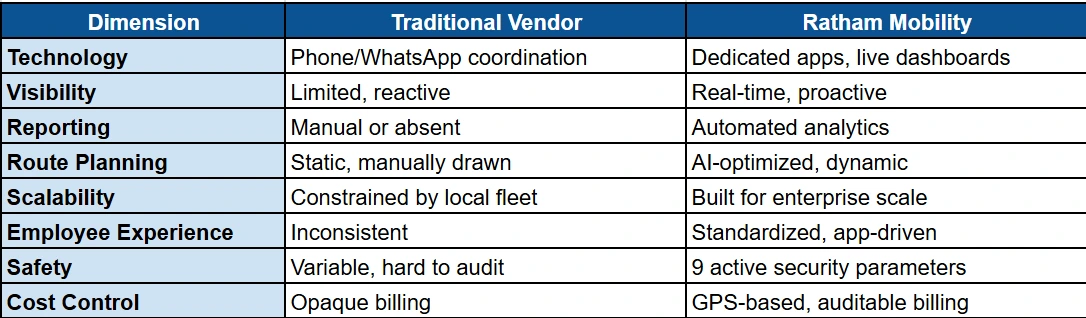
This isn't a marginal upgrade - it changes how predictably a company can scale transport as headcount or shift complexity grows.
Employee Transport Solutions for Different Industries in Pune
IT and Software Companies
Large campuses across Hinjewadi, Kharadi, and Baner run multiple overlapping shifts and a growing share of hybrid attendance, which requires flexible, demand-responsive routing rather than fixed daily fleets.
Global Capability Centres (GCCs)
GCCs typically operate against global parent-company standards for employee experience, safety documentation, and reporting. With GCCs now driving a substantial share of Pune's office leasing demandin 2025, the city recorded nearly 9.9 million sq. ft. of gross office leasing, with Global Capability Centres (GCCs) accounting for around 5.4 million sq ft, their transport requirements increasingly mirror international compliance and analytics standards rather than local vendor norms.
Manufacturing
Companies in Chakan, Talawade, and Pimpri-Chinchwad run fixed factory shifts on tight schedules, where late pickups have a direct production-line impact. Reliability and punctuality matter more here than route flexibility.
BPO and Shared Services
Round-the-clock operations mean night transport safety, driver verification, and SOS infrastructure aren't optional add-ons - they are core to the contract.
BFSI
Financial services firms place a premium on employee safety and business continuity, particularly for back-office and after-hours operations teams handling sensitive processes.
Key Locations Where Companies Need Reliable Employee Transport in Pune
Hinjewadi
Hinjewadi's Rajiv Gandhi Infotech Park spans roughly 2,800 acres across three phases and hosts hundreds of companiesThis is the home to the largest Rajiv Gandhi Infotech Park, which covers an area of 2,800 acres and accommodates over 800 firms that have employed over 300,000 professionals. The internal distance between Phase 1 and Phase 3 alone can mean a meaningful difference in commute time during peak hours, making precise, phase-aware routing essential for any provider serving this corridor.
Kharadi
Kharadi has emerged as one of Pune's fastest-growing GCC and BFSI corridors, anchored by the EON Free Zone and World Trade Centre Pune, hosting firms across banking, technology, and consultingWorld Trade Centre Pune is located in Kharadi area of Pune... Some of the top companies located here are ICICI, State Bank, Zuari, Bafna Exports. Nagar Road congestion makes this one of the more demanding corridors for predictable transport timing.
Magarpatta
Magarpatta City's integrated township model means many companies here - including Accenture, Capgemini, and HCL - sit within a self-contained business district, which simplifies last-mile routing compared to sprawling IT parks.
Baner
A fast-growing corridor for product companies, startups, and co-working-led businesses, Baner's transport needs increasingly favor smaller, more flexible vehicle formats over large fixed-route buses.
Hadapsar
A mixed commercial zone with both established IT offices and newer business parks, Hadapsar requires transport planning that accounts for a broader, more varied employee catchment area.
Chakan
Chakan's automotive and manufacturing clusters depend on fixed-shift, high-reliability transport, where late arrivals carry direct operational cost.
Pimpri-Chinchwad
One of Pune's older industrial belts, Pimpri-Chinchwad continues to host large manufacturing and engineering employers that need dependable, multi-shift transport at scale.
Talawade
A hybrid IT-and-manufacturing zone, Talawade requires providers capable of serving both white-collar shift patterns and factory-floor schedules within the same operational footprint.
Talk to a transport expert here.
How Technology Is Transforming Employee Transportation
Modern employee transport platforms increasingly rely on AI and machine learning for predictive routing, dynamic fleet allocation, and continuous route refinement based on actual traffic and ridership patterns - rather than fixed routes redrawn only once or twice a year. Live dashboards give admin teams visibility into every active trip, while mobile apps push real-time notifications to employees about pickup timing and delays. Automated GPS-based billing removes the manual reconciliation that historically caused most vendor disputes, and analytics layers turn raw trip data into actionable insight on cost per employee, seat utilization, and route efficiency.
Why EV Fleets Are Becoming the Future of Employee Transport in Pune
Corporate ESG commitments are pulling transport into the sustainability conversation directly, since employee commute typically falls under Scope 3 emissions reporting. EV fleets offer companies a tangible lever to reduce this footprint while also lowering per-kilometre operating costs over the vehicle's lifecycle, supported by state and central government incentives for commercial EV adoption. There's also a quieter but real factor: employees increasingly view their employer's transport choices - including EV adoption - as a signal of how seriously the company takes sustainability.
This is precisely where transport partners with genuine EV operating experience - not just a few EVs added to a brochure - create real value. Ratham has built its fleet strategy around owned EV capacity specifically for corporate commute use cases, giving companies a practical path to lower-emission transport without having to manage EV charging logistics or range planning themselves.
Read in detail about EV fleets in Pune here.
Why Leading Enterprises Choose Ratham for Employee Transport Services in Pune
Choosing a transport partner ultimately comes down to whether their operational capability matches the complexity of your campus, shift structure, and safety requirements. Here is how Ratham approaches each of the criteria outlined earlier in this guide.
Technology First
Ratham runs an AI-powered Employee Transport Management System (ETMS) that connects employee booking, driver operations, and admin oversight in a single platform - replacing the spreadsheet-and-phone-call coordination that still defines many traditional vendor relationships.
Diverse Fleet
Ratham's fleet spans EVs, sedans, SUVs, mini buses, and large buses, along with shuttle and premium options - letting companies match vehicle type to route density and shift seniority within a single contract rather than across multiple vendors.
Safety as a System, Not a Policy Document
GPS-based trip monitoring, SOS functionality, verified driver onboarding, and trip-level intelligence are built into Ratham's operating model, giving admin and HR teams an auditable safety trail rather than a one-time vendor assurance.
AI Route Optimization That Improves Continuously
Routes aren't fixed once and forgotten. Ratham's routing engine factors in live traffic conditions and historical ridership patterns to continuously refine pickup clustering and vehicle allocation as employee addresses and shift patterns change.
Automated, Trip-Level Billing
GPS-based billing tied to actual trip data reduces the back-and-forth disputes that commonly arise from manually estimated vendor invoices, giving finance teams a cleaner, auditable cost trail.
Built for Enterprise Scale
Ratham's operating model is structured to serve organizations ranging from a few hundred employees to 5,000+ across multiple campuses and shift patterns - without the fragmentation that comes from stitching together several local vendors.
Sustainability Built In
With an owned EV fleet already deployed for corporate commute routes, Ratham gives companies a credible, reportable path toward reducing commute-related Scope 3 emissions.
Employee Experience as the Outcome That Matters
Ultimately, every technology and safety investment is in service of one outcome: employees getting a reliable, predictable, comfortable commute - supported by live tracking and a dedicated mobile app that keeps them informed at every stage of the trip.
Talk to a transport expert here.
Checklist: How to Choose the Best Employee Transport Services in Pune
Does the provider own its fleet?
Owned fleets generally offer better accountability and consistency than fully outsourced vendor networks.
Is there a real technology platform?
Determines whether you get live visibility or rely on phone calls and guesswork.
Is GPS tracking standard across all vehicles?
Essential for safety audits and SLA enforcement.
Is there a dedicated employee mobile app?
Directly impacts employee satisfaction and adoption.
What women's safety protocols are in place?
A non-negotiable for night shift and rotational shift operations.
Can the provider produce compliance documentation on request?
Protects your company from regulatory and liability risk.
Is billing automated and GPS-based?
Reduces disputes and gives finance a clean audit trail.
Are analytics and reporting available to admin teams?
Enables ongoing cost and route optimization.
Does the provider offer EV fleet options?
Supports ESG and Scope 3 reporting goals.
How detailed is operational reporting?
Determines whether procurement can actually measure provider performance.
What does day-to-day support look like?
Determines how quickly issues get resolved during live operations.
Can the provider scale with your headcount growth?
Avoids a costly vendor switch as the company expands.
Know more about employee commute in Pune here.
Frequently Asked Questions
What is employee transport in a corporate context? It refers to organized commute services arranged by a company to move employees between their homes and office campuses, typically covering pickup and drop scheduling, route planning, and safety oversight.
How much does employee transport cost in Pune? Cost depends on fleet type, route density, shift count, and distance from employee clusters to the office. Companies using AI-optimized routing and shared seating typically see lower cost per employee than those running manually planned, single-occupancy trips.
Which industries in Pune require structured employee transport the most? IT and GCC firms, BPOs and shared services centers, manufacturing plants, and BFSI companies generally have the most complex and safety-sensitive transport needs due to shift patterns and after-hours operations.
Can employee transport be managed entirely through software? Yes. Modern platforms handle booking, route planning, live tracking, attendance, and billing through a single system, significantly reducing manual coordination effort for admin and HR teams.
How does GPS tracking benefit companies and employees? It gives admin teams live visibility into every trip, supports SLA enforcement, and gives employees confidence that their location and route are monitored throughout the journey.
How are women employees kept safe during night shift transport? Through verified driver onboarding, GPS-based trip monitoring, SOS or panic button access, and defined escort policies for late-night pickups and drops.
Can companies in Pune use EV fleets for employee transport? Yes. EV adoption for corporate commute is growing in Pune, supported by government incentives and rising corporate ESG commitments tied to Scope 3 emissions reporting.
How is billing typically calculated in modern transport platforms? Through GPS-based trip data rather than manually estimated distances, which produces a more accurate, auditable invoice.
How do companies reduce employee transport costs without cutting service quality? By using AI route optimization to reduce empty seats and dead mileage, consolidating vendors into a single technology-led provider, and using analytics to continuously refine routes.
How does AI improve employee transportation specifically? AI-driven routing clusters pickup points more efficiently, adjusts for live traffic, and reallocates vehicles dynamically as shift patterns or employee addresses change - something static, manually drawn routes cannot do.
What should be included in a transport vendor's compliance documentation? Valid vehicle permits, insurance, driver licensing and verification records, and adherence to applicable state transport regulations.
Is vendor consolidation worth it for large companies running multiple shifts? Generally yes, since consolidating to a single technology-led provider reduces coordination overhead, simplifies billing reconciliation, and improves accountability compared to managing several local vendors.
Conclusion
Pune's rapid corporate growth - spanning IT, GCCs, manufacturing, and BFSI across corridors like Hinjewadi, Kharadi, Magarpatta, Baner, and Chakan - demands a more intelligent approach to employee mobility than the traditional cab-vendor model can offer. With the city now ranked among the world's most congested for daily commuting, organizations that invest in reliable, technology-enabled Employee Transport Services Pune can meaningfully improve employee experience, reduce operational costs, strengthen safety and compliance, and support sustainability goals. Providers such as Ratham, which combine fleet operations with an AI-powered employee transport platform, owned EV capacity, and enterprise-scale operating discipline, are well positioned to help companies modernize corporate mobility across Pune's IT parks, GCCs, manufacturing hubs, and corporate campuses.
Looking for Employee Transport Services in Pune?
If your organization is reassessing its corporate commute program - whether due to growth, safety gaps, rising costs, or sustainability targets - it's worth starting with a structured transport assessment rather than a like-for-like vendor swap. Ratham works with companies across Hinjewadi, Kharadi, Magarpatta, Baner, Hadapsar, Chakan, and Pimpri-Chinchwad to evaluate current routes, shift patterns, and safety gaps, and to map out where AI-powered routing, fleet diversification, and EV adoption can make the most measurable difference. Schedule a consultation to request a transport assessment for your campus.
Talk to a transport expert here.
References
TomTom Traffic Index 2025 - Pune City Report, tomtom.com/traffic-index/city/pune
Outlook Traveller, "TomTom Traffic Index 2025: Bengaluru, Pune Among World's Slowest Cities In India"
ForumIAS, "TomTom Traffic Index 2025" - Pune congestion ranking and Asia comparison
IAS Gyan, "India Ranks High on TomTom Traffic Index 2025: UPSC Current Affairs"
Sharpener Tech, "Top 25 IT Companies in Pune to Watch in 2025"
Lexifo, "Top 20 IT Companies in Pune (2026) – Ranking, Jobs & Salary"
Lexifo, "Top 15 IT Companies in Hinjewadi 2026 (Updated Ranking)"
Yukio, "Best IT Companies in Pune: Hinjawadi, Kharadi & More"
Zolostays, "Tech Parks in Pune: Top Hubs Every Engineer Aspires to Work"
Author: This guide was prepared by Ratham's corporate mobility team, drawing on operational experience managing employee transport programs across Pune's IT, GCC, and manufacturing corridors.