
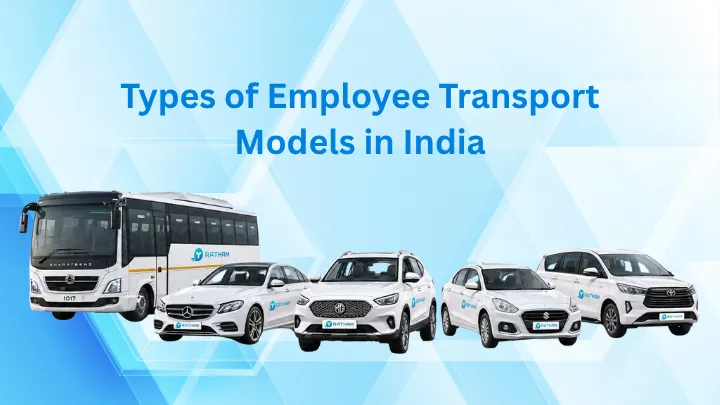
Types of Employee Transport Models in India: Cabs, Shuttles, Buses and Fleet Rentals
A detailed guide on Types of Employee Transport Models in India compiled by transport experts at Ratham.
India's employee transport models fall into four types: corporate cabs, shuttles, buses and monthly fleet rentals. Cabs suit scattered, multi-shift workforces. Shuttles and buses suit concentrated campuses and fixed routes. Fleet rentals suit leadership, guests and variable demand. Most large employers run a blend, chosen by shift pattern, headcount and geography.
The four employee transport models at a glance
Each model answers a different question: how many people travel, when they travel and how far apart they live. The table below summarises how the four compare. The sections after it explain each one.
1. The four employee transport models at a glance
Corporate cabs (pooled or dedicated)
How it works: Cars or SUVs collect small groups of employees from or near home, on routes planned around each shift roster.
Best suited to: Scattered home locations, night and rotating shifts, and variable headcount per shift.
Strongest fit: Many shifts, dispersed catchments, and situations where door-to-door pickup is expected.
Watch-outs: Cost per employee rises when seats go empty. Routes need frequent re-planning.
Employee shuttles
How it works: Larger vehicles run planned routes between defined pickup points and the office. Employees often reserve seats in an app.
Best suited to: Concentrated employee clusters on predictable routes with regular shift times.
Strongest fit: High headcount per shift, dense corridors, campuses and IT parks.
Watch-outs: Needs enough riders on every route. Pickup points are fixed, so some employees travel to a node.
Corporate buses
How it works: Full-size buses carry large groups on fixed routes, often between offices, campuses, factories or transit points.
Best suited to: Very high volumes on a small number of routes.
Strongest fit: Large shifts that start and end together, or one large site.
Watch-outs: Less flexible for small or late-night shifts. Depends on route density.
Monthly fleet rentals and dedicated vehicles
How it works: A vehicle, usually with a driver, is contracted for exclusive use by a person, team or function.
Best suited to: Leadership, guests, client-facing teams, airport transfers and variable demand.
Strongest fit: Low-volume requirements with high flexibility and a premium experience.
Watch-outs: Paid for the full contract period whether or not it is used. Not built for mass shift commute.
Corporate cabs: door-to-door commute for scattered, multi-shift teamsCorporate cabs move small groups of employees in sedans or SUVs, with vehicles and routes planned for each shift. They are the default model for IT, ITES, BPO and GCC organisations whose employees live across a wide area and work rotating or night shifts.
Cabs come in two common forms:
• Pooled cabs: employees from nearby localities share a vehicle on a planned route, and the cost is spread across riders.
• Dedicated cabs: a vehicle is assigned to one employee or a small group, usually for senior staff or specific needs.
When cabs suit an organisation
• Employees live in many different localities, so no single route fills a larger vehicle.
• Shifts start and end at varied times, including nights.
• Headcount per shift is moderate, or changes every week with the roster.
• Employees expect pickup close to home, which matters most on night shifts.
When cabs are the wrong fit
• Hundreds of employees start the same shift from the same few areas. A shuttle or bus usually carries them at a lower cost per seat.
• Rosters change so late that routes cannot be planned in time.
What to check before choosing cabs
Routing quality matters more here than in any other model, because every empty seat is still paid for. Ask how routes are generated and re-planned when rosters change, what backup vehicles are available, and whether live tracking, SOS and driver verification are built in. Ask also whether invoices are validated against recorded trip data.
Employee shuttles: seat-based routes for concentrated clusters
Employee shuttles run planned routes between defined pickup points and the workplace. Employees reserve seats instead of being collected individually. The model suits organisations where many employees live along the same corridors and shifts follow a regular schedule.
The difference from cabs is structural. Cabs are planned around individuals and small groups. Shuttles are planned around routes, pickup points and seat capacity, so the key measures are occupancy and seat utilisation rather than vehicle allocation.
When shuttles suit an organisation
• Large campuses, IT parks and business parks with many employees on the same corridors.
• Predictable shift timings, so routes can run on a stable schedule.
• A need to right-size capacity using real occupancy data instead of estimates.
• Employees who can reach a defined pickup point without difficulty.
When shuttles are the wrong fit
• Employees are spread so widely that few of them share a route.
• A late-night shift has only a handful of riders on each route.
• Policy or law requires pickup close to the residence for certain employees. Check this for women on night shifts (see the compliance section below).
What to check before choosing shuttles
Look for seat booking, live arrival times for employees, boarding verification by QR, RFID or OTP, and occupancy reports that show which routes to merge, split or drop. A shuttle programme without utilisation data tends to drift into running half-empty vehicles.
Click Here to Talk to a Transport Expert
Corporate buses: capacity for large, predictable movements
Corporate bus transportation uses larger passenger vehicles for groups that exceed what cabs and smaller shuttles can carry economically. A shuttle is the programme: structured routes, seat management and boarding. A bus is one vehicle category that can operate that programme.
Typical uses include office-to-office movement, campus loops, factory shift changes, links to transit points and fixed-route employee commute.
When buses suit an organisation
• One large site, plant or campus where many employees start and finish together.
• Routes where a full bus load boards within a short stretch of road.
• Transit-point feeders that carry employees between a metro or rail station and the office.
When buses are the wrong fit
• Small shifts, or shifts at unusual hours with few riders.
• Last-mile roads that a large vehicle cannot use comfortably.
• Low-density routes where a bus would run mostly empty.
What to check before choosing buses
Buses need the same discipline as other models, with higher stakes per vehicle. Ask about permit status, driver and vehicle compliance, speed and safety monitoring, seat management and how billing is verified. Because a single route can carry dozens of employees, a missed trip affects far more people than a missed cab.
Monthly fleet rentals and dedicated vehicles: flexibility for leadership, guests and variable demand
A monthly fleet rental gives an organisation a contracted vehicle, usually with a driver, for exclusive use over a fixed period. It is booking-driven rather than roster-driven, so it serves a different need from the shift commute.
Common uses include leadership movement, visiting executives, client and guest transport, airport transfers, business meetings and travel for teams that move around during the day.
When fleet rentals suit an organisation
• A few people need dependable, premium or on-call transport.
• Demand is hard to predict, so fixed routes would not work.
• A function, such as sales or facilities, needs vehicles at its own disposal.
When fleet rentals are the wrong fit
• The requirement is a daily shift commute for hundreds of employees. A dedicated vehicle per person is not economical at that scale.
What to check before choosing a rental
Confirm exactly how charges work: kilometres travelled, minimum usage, waiting time, tolls and taxes. Ask for approval workflows that match your hierarchy, live location and arrival times for guests, and GPS-verified mileage on every invoice.
How shift patterns, headcount and geography decide the right model
Three variables decide the model more than any others: when employees travel, how many travel together, and how far apart they live. Cost per employee trip is the result of those three, not a separate choice.
Shift patterns
• One fixed shift with a narrow arrival window: shuttles and buses lead, because large numbers travel at the same time on the same routes.
• Several staggered shifts: cabs carry the thinner shifts, while shuttles stay on the heaviest corridors. Each extra shift splits the rider pool and lowers occupancy.
• 24×7 or night operations: door-to-door cabs usually carry the night. Late routes have fewer riders and need closer monitoring.
• Rosters that change weekly: routing must be automated. Manual planning is the first thing to fail when rosters keep shifting.
Headcount
What matters is headcount per shift per corridor, not total headcount. Consider two illustrative organisations, each with 2,000 employees. One has them spread across 40 localities and four shifts. That is a cab-led programme. The other has them on a single shift from six corridors. That is a shuttle and bus programme.
Geography
• Concentrated corridors: employment clusters such as Hinjewadi and Kharadi in Pune, OMR in Chennai, the Outer Ring Road in Bengaluru, HITEC City and Gachibowli in Hyderabad, or Cyber City in Gurugram create shared routes. Shuttles and buses work where employees live along the same corridors.
• Dispersed catchments: where employees live across a large metro, cabs remain the practical choice.
• Multiple offices or cities: each location may need a different mix, which makes one common platform and reporting structure important.
A worked example: cost per employee trip
The formula is simple: cost per employee trip equals the cost of one route run divided by the employees actually carried. The figures below are illustrative arithmetic, not Ratham prices or market benchmarks.
2. Cost per employee trip – illustrative examplesThe formula is simple: cost per employee trip equals the cost of one route run divided by the employees actually carried.
The following examples are illustrative arithmetic, not Ratham prices or market benchmarks.
Scenario 1: Cab with all seats occupied
Cost of one route run: ₹1,200
Employees carried: 4
Cost per employee trip: ₹300
Scenario 2: Cab with half the seats occupied
Cost of one route run: ₹1,200
Employees carried: 2
Cost per employee trip: ₹600
Scenario 3: Shuttle with all seats occupied
Cost of one route run: ₹4,000
Employees carried: 40
Cost per employee trip: ₹100
Scenario 4: Shuttle with partial occupancy
Cost of one route run: ₹4,000
Employees carried: 15
Cost per employee trip: Approximately ₹267
Occupancy moves cost more than the model label does. A half-empty shuttle can cost almost as much per employee as a full cab. This is why real route and occupancy data should decide the model, not habit.
Occupancy moves cost more than the model label does. A half-empty shuttle can cost almost as much per employee as a full cab. This is why real route and occupancy data should decide the model, not habit.Click Here to Talk to a Transport Expert
Which model fits which situation: a decision guide
Start with your own roster data and answer six questions. How many employees travel per shift on each corridor? How many distinct shift start times do you run? How spread out are home locations? Do any shifts run at night? Which employees need premium or on-call transport? How stable are rosters week to week?
Then use the table below as a starting point. It is a guide for shortlisting, not a substitute for route-level analysis.
3. Which model fits which situation: a decision guideSeveral rotating shifts, with employees spread across a city
Likely model: Pooled corporate cabs.
Why: Door-to-door pickup, flexible routing, and moderate headcount per route.
One campus or IT park, with one or two fixed shifts and dense corridors
Likely model: Shuttles, with buses on the heaviest routes.
Why: Many riders share routes, so cost per seat falls.
Plant or factory where hundreds of employees change shifts together
Likely model: Corporate buses, with cabs for off-hours.
Why: Capacity matches the surge at shift change.
24×7 BPO or GCC with women on night shifts
Likely model: Door-to-door cabs for night shifts and shuttles for day shifts.
Why: Night routes carry fewer riders and have stricter safety and transport requirements.
Leadership, visiting executives, client and guest travel
Likely model: Monthly fleet rental or dedicated vehicle.
Why: Booking-driven, premium and on-call transport.
Multiple offices or cities with different workforce patterns
Likely model: A blend by location on one platform.
Why: Each site gets its own mix, with common reporting and standards.
Employees commuting from a transit hub
Likely model: Shuttle feeder between the hub and office.
Why: Replaces many individual trips over the same short route.
Why most large employers run a blend of modelsMost large employers combine models because their workforce is never uniform. A typical arrangement uses shuttles on dense daytime corridors, cabs for night shifts and outlying areas, buses for a plant or large campus, and rented vehicles for leadership and guests.
The risk is fragmentation. When each model comes from a different vendor with a separate app and invoice, an organisation loses sight of occupancy, safety exceptions and total transport cost. Four practices keep a blend manageable:
1. One routing and tracking platform across all models, so every trip is recorded in the same format.
2. Common safety and compliance standards, covering driver verification, vehicle documents, SOS and escalation, whichever vehicle is used.
3. Billing validated against trip data, so kilometres and charges can be checked the same way for cabs, shuttles and buses.
4. A regular route review, using occupancy and on-time data to merge thin routes, split overloaded ones and move employees between models as rosters change.
The point of a blend is that the model follows the data. When a corridor grows, a shuttle replaces several cabs. When a shift shrinks, the shuttle gives way to pooled cabs.
Safety, compliance and permits across every model
Three compliance layers apply whichever model you choose: night-shift obligations for women employees, vehicle permits, and driver and vehicle document checks. This section summarises them for planning. It is general information, not legal advice, and rules vary by state.
Night-shift rules for women employees
Section 43 of the Occupational Safety, Health and Working Conditions (OSH) Code, in force since 21 November 2025, permits women to be employed before 6 a.m. and after 7 p.m. with their consent and subject to prescribed conditions. The OSH (Central) Rules, 2026, notified on 8 May 2026, set out those conditions in Rule 83. According to a legal analysis by King Stubb & Kasiva, they include:
• written consent from the woman employee;
• adequate transportation for pick-up and drop-off at her residence;
• dedicated emergency numbers displayed at the workplace and inside vehicles used for transport;
• adequate lighting and CCTV coverage on workplace routes, plus compliance with the POSH Act and maternity benefit provisions.
Two cautions apply. First, the Central Rules apply only to establishments where the Central Government is the appropriate government, and state governments notify their own rules, so confirm the position in each state you operate in. Second, a nodal-point shuttle may not satisfy a requirement to drop an employee at her residence. Check with your legal adviser, and keep consent, roster, vendor and route-monitoring records.
Vehicle permits
Passenger vehicles carrying people for hire need permits under the Motor Vehicles Act, 1988. The permit follows how you pay for the service. When a company hires a whole vehicle to move its staff on agreed routes, that is a contract carriage arrangement under Section 74 of the Act. Collecting individual fares along a route is stage carriage, which is a different permit. State rules for app-based shuttle and bus models are still evolving, so ask any provider to show current permits for every vehicle category and state.
Driver and vehicle compliance
Whatever the model, ask a provider to show how it verifies and tracks:
• driver identity, licence and background checks;
• vehicle documents such as insurance, fitness and permits, with renewal alerts before expiry;
• live monitoring for SOS, overspeeding, unexpected stops, offline devices and route deviations;
• safe-reach confirmation at the end of each trip;
• records that can be produced for an audit.
Electric vehicles across the four models, and Scope 3 reporting
Electric vehicles can run in every model, but the model affects how easy the transition is. Fixed-route shuttles and buses have predictable daily distances, which makes range and charging easier to plan. Cabs on rotating rosters need route-level range planning and backup capacity.
The case for starting with employee transport is strong. The WBCSD's India business guide to EV adoption names employee transport as one of three highly scalable fleet use cases, noting that limited public transport in large Indian cities makes commute services a core need.
Employee transport also feeds sustainability reporting. Under the GHG Protocol, Scope 3 Category 7 covers emissions from employees travelling between home and worksites, including the emissions of third-party transportation providers. An employer-arranged commute therefore appears in that category, and trip-level data makes it easier to report.
When assessing an EV transition, look beyond the share of EVs in the fleet. Ask for utilisation, trips per vehicle per day, charging downtime, backup-vehicle use and cost per kilometre, measured against your own shifts and routes.
Where Ratham fits
Ratham suits enterprises that run more than one of these models and want them managed as one operation. It combines an Employee Transport Management System (ETMS), a fleet of owned and partner-operated vehicles, and 24×7 operations teams. That connected model matters most for organisations with multiple shifts, locations and vehicle categories that would otherwise manage separate fleet and software vendors.
Ratham's published company figures, as of November 2026, include a fleet network of 3,500+ owned and partner-operated vehicles, 200+ owned EVs and 60,000+ trips a month. Its fleet categories are sedans, luxury sedans, SUVs, EVs and buses.
Click Here to Talk to a Transport Expert
How Ratham supports each model
4. How Ratham supports each employee transport modelCorporate cabs
What Ratham provides: Sedans, luxury sedans, SUVs and EVs from owned and partner fleets, with vehicle and driver allocation.
Supporting technology: AI routing, employee and driver apps, GPS dashboard and automated billing.
Employee shuttles
What Ratham provides: Shuttle route planning and seat management for campuses and corridors.
Supporting technology: Seat booking, live ETA, QR, RFID or OTP boarding, and seat-utilisation reports.
Corporate buses
What Ratham provides: Bus sourcing and deployment, route and schedule planning, and driver and vehicle compliance.
Supporting technology: Live tracking, security dashboard, billing and reporting.
Fleet rentals and premium travel
What Ratham provides: Premium rentals, airport transfers and executive vehicles booked by app, portal, email or WhatsApp.
Supporting technology: Approval workflows, live ETA and GPS-verified mileage for invoices.
EV transition
What Ratham provides: EV fleet deployment and transition programmes for commute operations.
Supporting technology: Sustainability dashboard with Scope 3 Category 7 reporting support.
Vehicle capacities, models and city availability are confirmed with the customer during scoping.How an engagement works
Enterprises can use Ratham's ETMS with their existing vendors, engage Ratham for managed transportation that brings platform, fleet and operations together, or add shuttle, bus, premium rental and EV services to either arrangement. Onboarding follows five phases: discovery, set-up, pilot, roll-out and governance, with regular SLA reviews.
Trip data is what ties the models together. Billing Forensics, for example, compares GPS trip records with billed kilometres, and separates legitimate detours such as traffic diversions from unauthorised route deviations. It supports verification and does not guarantee that every billing error will be eliminated.
What clients say
• "Ratham helped us reduce transport costs by 15%, and their safety features give peace of mind to our night-shift teams." Vice President, Facilities and Operations, a leading ITES company. This is one client's reported result, not an average across clients.
• "Their route optimization has helped us reduce costs while maintaining safety as the top priority." Procurement Manager, Rolls-Royce India.
When a different model may serve you better
A very small team on a single day shift, with few employees commuting, may find that a local vendor or reimbursed ride-hailing is simpler. An organisation that wants software only, because it is committed to its current fleet vendors, can adopt an ETMS without a managed fleet. Ratham offers both options, and the right one depends on your roster data.
Frequently asked questions
What are the main types of employee transport in India?
The four main types are corporate cabs, employee shuttles, corporate buses and monthly fleet rentals. Cabs serve scattered, multi-shift teams. Shuttles and buses serve concentrated routes. Fleet rentals serve leadership, guests and variable demand. Many employers combine them.
Which employee transport model is the cheapest?
No model is cheapest in every case. Cost per employee trip equals route cost divided by employees carried, so occupancy decides the result. Shuttles and buses generally cost less per seat on dense corridors, while cabs often cost less on dispersed, low-volume routes.
Should night shifts use cabs or shuttles?
Night shifts usually use door-to-door cabs, because routes carry fewer riders and employees expect pickup near home. For women working at night, the Central Rules require adequate pick-up and drop-off at the residence. Confirm how this applies in your state before using nodal-point shuttles.
How many employees justify a shuttle or bus?
There is no fixed number. A shuttle needs enough riders from the same corridor on the same shift to keep occupancy high. Measure employees per route per shift from your roster data before deciding.
Can a company use more than one transport model?
Yes. Most large employers use a blend, such as shuttles on dense daytime corridors, cabs for night shifts and outlying areas, and rented vehicles for leadership. A single platform for routing, tracking and billing keeps the blend manageable.
Does an employer have to provide transport for employees?
It depends on the employee and the state. For women working before 6 a.m. or after 7 p.m., adequate transport is a condition under the OSH Central Rules where they apply. Beyond that, provision is usually a matter of company policy and applicable state rules. Take legal advice for your establishment.
What is an Employee Transport Management System (ETMS)?
An ETMS is software that plans, runs and monitors employee transport. It covers booking, route optimisation, vehicle allocation, live tracking, safety alerts, billing and analytics. It lets an organisation manage cabs, shuttles and buses in one place.
Discuss your employee transport requirements with Ratham
Share your sites, shifts and headcount, and Ratham's team can help map which mix of cabs, shuttles, buses and rentals fits your workforce.
• Email: connect@ratham.com
Click Here to Talk to a Transport Expert
Sources
Reviewed on 20 November 2026. Legal summaries below are secondary sources and should be checked against the notified rules and current state notifications before reliance.
• Women in Night Shifts Under the OSH Code: Key Conditions and Employer Compliance Requirements, King Stubb & Kasiva, published 9 October 2026, updated 5 November 2026.
• The next phase of workforce compliance: What the newly notified Central Labour Rules mean for employers, Bar & Bench.
• Technical Guidance for Calculating Scope 3 Emissions, Chapter 7: Employee Commuting, GHG Protocol.
• Section 74, Motor Vehicles Act, 1988: grant of contract carriage permit.
• Maxi cab and staff van: contract carriage permit check, VahanBazaar.
• India Business Guide to EV Adoption, WBCSD.
• Ratham company materials: Pune employee transport brochure and service and product knowledge base, November 2026.